
IMS
One integrated management system for five ISO standards
Write the policy once, audit the process once and close the finding once, whichever standard asked for it.
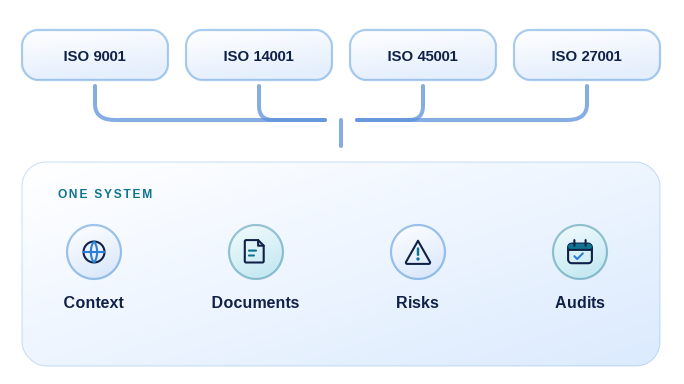
What an integrated management system is
The ISO standards were built on a common structure. Clauses 4 to 10 are largely the same shape in ISO 9001, 14001, 45001, 27001 and 22301. That is what makes integration possible.
So instead of a document set, a risk register and an audit programme for every standard, you keep one of each and every standard draws what it needs. Integration is where most of the saving in a multi-standard system lives. It is also the part spreadsheets cannot give you, because nothing in them knows that two records are the same record.
The shared spine
What gets shared, and what stays specific
The common clauses are held once; the standard-specific registers stay separate, because they should be.
Context and interested parties
Internal and external issues, stakeholders and their requirements, and legal and regulatory obligations. Each is written once, with review dates and owners, and referenced by every standard.
Objectives that carry through
Objectives link to the management systems they serve, to the stakeholders who care about them, and to the change controls that alter them. One objective can answer to quality and environment at the same time.
One document library
Policies, processes and documents with versions, diffs, approvals and mandatory assignments. A procedure that satisfies three standards is one document with three links.
One risk register
Risks, treatments and controls in a single register with a shared matrix. A supplier risk is a quality risk and a security risk without being entered twice.
One audit programme
Plan audits across every standard on one calendar, with questionnaires and templates, evidence linked to findings, and a capture review before anything is accepted.
One improvement loop
Nonconformances, root cause, corrective actions and change control in one place, feeding a single management review that covers the whole system.
How integration works in practice
Integrated management system questions
- Which standards can be integrated?
- Any of the ISO management system standards that share the common clause structure. Objectly ships modules for ISO 9001, ISO 14001, ISO 45001, ISO 27001 and ISO 22301, and they can be run together as one system.
- Can we be certified to several standards from one integrated system?
- Yes. That is the usual reason to build one. Certification bodies audit integrated systems routinely and often combine the audits, which is usually where the visible cost saving appears. Objectly holds the system; the certification body still issues the certificates.
- Is an IMS harder to maintain than separate systems?
- It is usually easier, because there is less of it. The difficulty with separate systems is keeping four copies of the same policy, risk or supplier assessment in agreement. An integrated system removes the duplication altogether.
- What if only part of the business is in scope for one standard?
- Scope is set per management system, so ISO 27001 can cover one site or one service while ISO 9001 covers the whole organisation. The shared records stay shared; the scope statement is what differs.
Related
The standards it brings together
ISO 14001 environment
Environmental aspects, obligations and impacts in a system that keeps them current.
ISO 45001 health & safety
Hazards, chemicals, PPE, inspections and toolbox talks in one health and safety system.
ISO 27001 information security
Annex A, the Statement of Applicability, risks and evidence in one ISMS.
ISO 22301 business continuity
Continuity plans by process, recovery targets, and exercises recorded against them.
See an integrated system in action
Bring the standards you hold and we will show you what integration removes.
No obligation and no credit card required.